CHOOSING THE RIGHT BRONCHOSCOPE: EXPERT INSIGHTS
Why Choosing the Right Bronchoscope Matters: Insights from Dr. Mark Dauster
Bronchoscopy remains a cornerstone of modern airway management – yet device performance can significantly influence outcomes.
With more than 20 years of experience in anesthesiology at BGU Hospital, Dr. Mark Dauster manages both anticipated and unexpected difficult airways in the operating room. For him, choosing the right bronchoscope is not simply a matter of preference – it is a matter of safety, efficiency and reliability.
“In addition to medical and organisational challenges, technical issues are very important,” says Dr. Dauster. “Limited visibility and anatomical variations can significantly affect the procedure.”
What really matters when choosing a bronchoscope?
Beyond economic aspects, technical factors are often underestimated. Although image quality and handling influence usability, suction performance often proves decisive in daily practice.
While high-resolution imaging is essential in pulmonology, Dr. Dauster believes that functional performance may be more critical. Responsiveness, flexibility and stability directly affect control, particularly in complex or emergency situations.
In these scenarios, maintaining a clear visual field is essential – and suction power plays a decisive role. “You need high suction power for the rapid removal of secretions, blood or irrigation solution. High suction power brings better visibility,” he explains.
A larger working channel further supports efficiency, facilitating flushing, suctioning and instrument movements, even when the scope is bent. “That saves time – and time is security for the patient,” Dr. Dauster adds.
Are single-use bronchoscopes changing practice?
For Dr. Dauster, hygiene is a key advantage of single-use bronchoscopes. Eliminating reprocessing reduces cross-contamination risk and makes these devices particularly suitable for ICU isolation settings.
Single-use devices also offer more consistent performance. “With reusable devices, maximum performance can decrease over time,” he explains, referring to reduced flexibility or diminished suction power after repeated use.
However, he notes that procurement decisions often focus too narrowly on acquisition costs. “Preparation, maintenance, repairs, replacement equipment and personnel costs are extremely high when using reusable bronchoscopes,” he explains.
Dr. Dauster describes the shift toward single-use technology as a potential “paradigm shift” while acknowledging that highly specialised interventions may still require reusable systems.
Evaluating performance in practice
To better understand differences in suction performance, Dr. Dauster and a colleague conducted a structured internal comparison. They thickened water to four different viscosities and compared how long the three bronchoscopes from well-known manufacturers took to completely remove the solution.
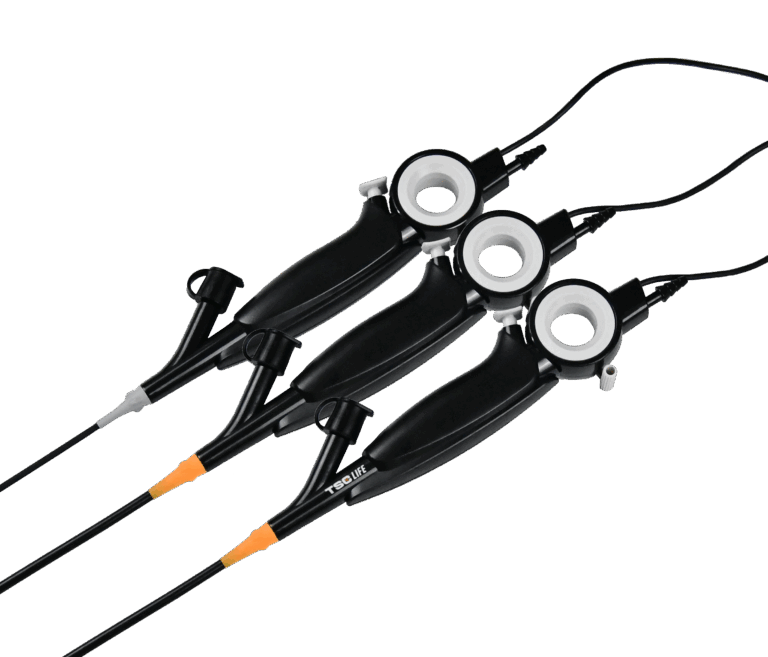
In this comparison, the TSC Life XFlow bronchoscope was noticeably faster. While early versions showed limitations in image quality, Dr. Dauster notes that this has improved significantly with recent developments. “It was noticeably faster in removing the prepared solution,” he says, adding that performance consistency and handling are key factors in daily practice.
Ultimately, selecting a bronchoscope is not about a single feature, but about consistent performance under real-world conditions where visibility, suction and reliability must work together.